
The Taichung Power Plant (TPP, 台中火力發電廠) currently has a total installed capacity of 5,780 MW from oil- and coal-fired units. Since 2018, Taiwan Power Company (Taipower) has pursued a ‘coal-to-gas’ transition policy, proposing Phase I (2,600 MW) and Phase II (5,500 MW) gas-fired projects. These would bring total gas-fired installed capacity to 8,100 MW—a figure that alone would make TPP the world’s largest thermal power plant. Moreover, the gas-fired projects would not fully replace the existing coal-fired generation: six coal-fired units would remain as backup units.
In 2024, the Taichung Power Plant Phase II gas-fired project passed the first-stage Environmental Impact Assessment (“EIA”). Residents subsequently filed an administrative lawsuit. The plaintiffs argued that:
After completion, the project is expected to continue emitting approximately 21,160 kt of greenhouse gases annually, compared with 26,548 kt in 2022, representing only a very limited reduction in emissions. The project could continue operating and emitting greenhouse gases beyond 2050, yet it does not provide a timeline for phasing out the six gas-fired units and six backup coal-fired units. This is inconsistent with Taiwan’s 2050 net-zero target.
Furthermore, methane is the primary component of natural gas. Over a 20-year period, methane has a global warming potential approximately 82 times that of carbon dioxide and is therefore often referred to as a “super pollutant.” Methane leakage occurs during the transportation, loading and unloading, and storage of natural gas. Such leakage not only increases greenhouse gas emissions but may also create risks of accidents such as explosions and fires. Nevertheless, Taipower failed to assess the environmental impacts of methane leakage and propose corresponding mitigation measures.
With respect to air-pollution impacts, Taipower submitted incorrect and less stringent air-quality standards for consideration. Although serious exceedances of air-quality standards were anticipated during the construction period, the authorities did not require the project to undergo a second-stage EIA as required by law. Even more seriously, the project failed to conduct the legally required assessment of air-pollution impacts during the operational phase and to propose corresponding mitigation measures.
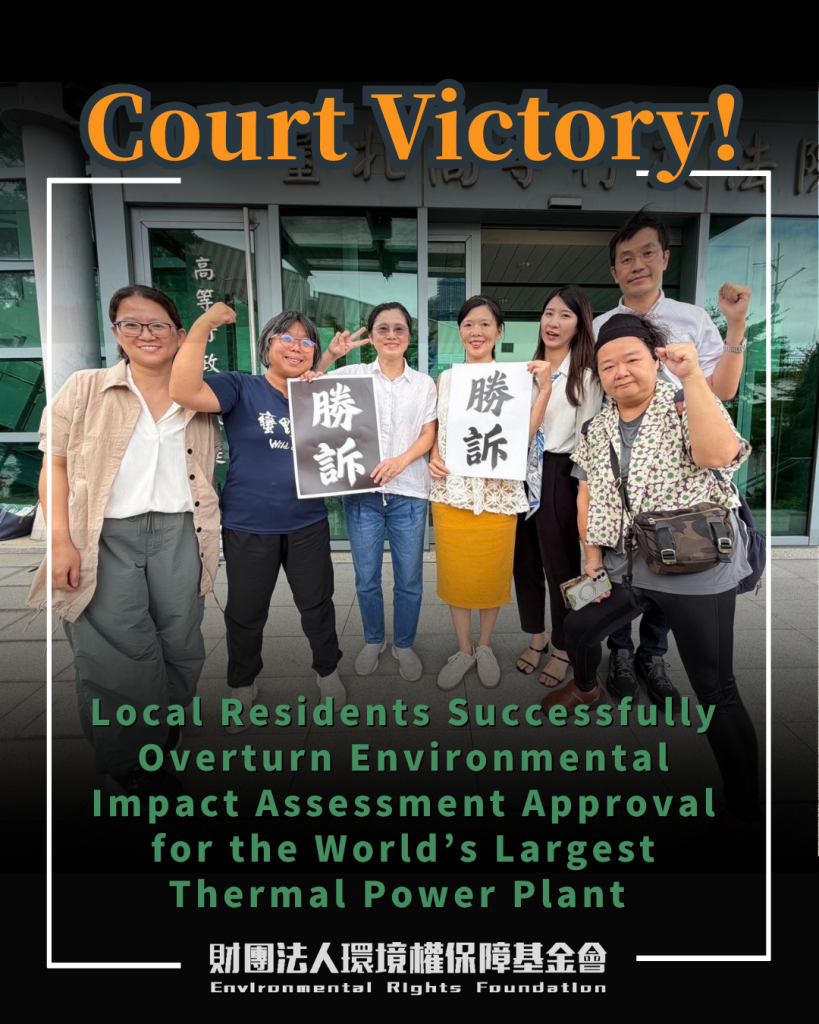
Court overturns the EIA approval today (October 8th)
Today, the Taipei High Administrative Court issued its judgment, revoking the first-stage EIA approval for the Taichung Power Plant Phase II gas-fired project.
We call on the Ministry of Environment and Taipower to:
- Waive the right to appeal and proceed directly to a second-stage EIA.
- Reduce the installed capacity of the Phase II gas-fired project to 2,600 MW, taking into account the environmental carrying capacity of the region.
- Establish clear criteria governing the activation of the backup coal-fired units, based on the approach taken in the Phase I gas-fired project, and develop phase-out plans for all six coal-fired units and six gas-fired units.
- Include methane leakage in the assessment of greenhouse gas emissions, and establish methane MRV (Monitoring, Reporting and Verification) and LDAR (Leak Detection and Repair) mechanisms.
- Assess the feasibility of implementing CCUS across all thermal power generation units at the Taichung Power Plant and implement it where feasible.
- Conduct an assessment of air-pollution impacts during the operational phase and apply the latest air-quality standards.
#EnvironmenatlJustice #EnvironmentalImpactAssessment #TaichungPowerPlantPhaseII
